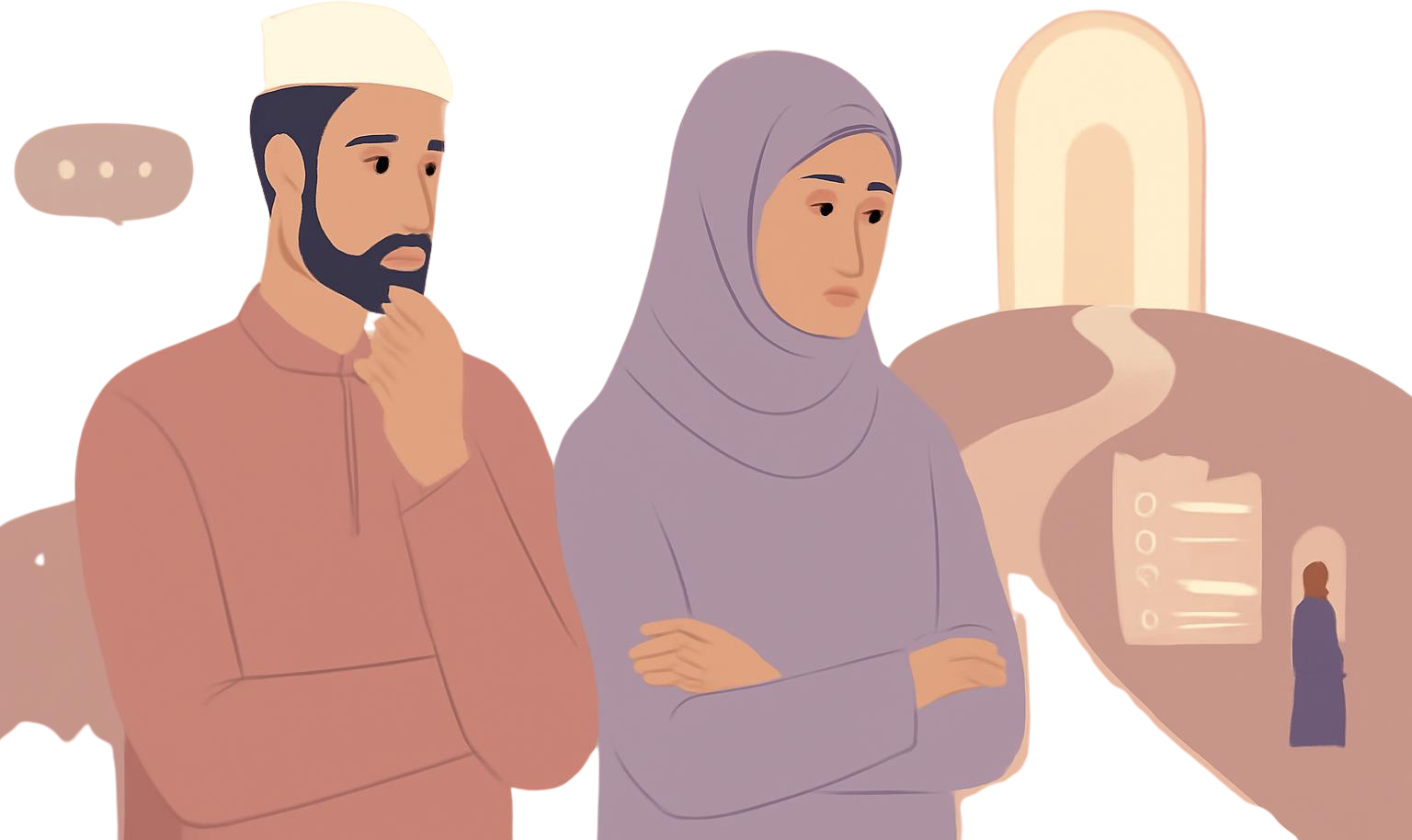
Marriage readiness is often discussed as though it were a single feeling: certainty.
You meet someone, the conversations become serious, the families become aware, and eventually you are expected to know whether this is the person you should marry.
But readiness is rarely that simple. A person can feel emotionally certain while remaining practically unprepared. They can have sincere intentions while avoiding necessary conversations. They can share faith, attraction and affection while holding very different expectations about what married life will actually involve.
The most useful question is therefore not only, “Do I want to marry this person?”
It is also, “What kind of life are we realistically preparing to build together?”
Marriage Readiness Is More Than Wanting Marriage
Wanting to be married does not automatically mean someone is ready for marriage.
A person may genuinely desire commitment while still struggling with responsibility, communication, emotional regulation, money, family boundaries or the ability to make difficult decisions. None of this necessarily makes them a bad person. It may simply mean their desire has developed faster than their readiness.
Readiness becomes visible through behaviour. It can be seen in whether someone follows through, speaks honestly about difficult subjects and accepts that marriage requires more than romantic reassurance.
It also appears in the way they respond when the conversation becomes uncomfortable. Can they discuss expectations without becoming defensive? Can they acknowledge uncertainty without disappearing? Can they hear a concern without treating it as rejection?
The answers often reveal more than affectionate words ever could.
Attachment Can Quietly Change the Question
At the beginning of a marriage-focused relationship, you may be trying to discover whether the person is compatible with you.
Once attachment develops, the question can subtly change. Instead of asking whether the match is healthy and workable, you may begin asking how to preserve it.
Delays become understandable. Differences become temporary. Unanswered questions are filled with hopeful assumptions. You may focus more on the possibility of losing the relationship than on what the relationship is actually showing you.
This does not mean your feelings are false. It means that strong feelings can make objective evaluation more difficult.
A detailed guide to Muslim marriage readiness before nikah can help separate emotional attachment from the practical, relational and faith-aware questions that still need answers.
Compatibility Appears in Ordinary Life
Compatibility is easy to imagine when conversations remain romantic and hypothetical.
Two people may agree that they value family, faith, loyalty and respect. Yet those words can represent completely different expectations.
What does family involvement look like after marriage? How much influence will parents have over major decisions? What level of religious practice is expected inside the home? How will money be managed? Who will work? Where will the couple live? How will household responsibilities be divided?
Even apparently simple values need practical definitions.
One person may describe themselves as family-oriented because they want frequent contact with relatives. The other may use the same description while believing that married couples should maintain strong privacy and independence.
Neither understanding is automatically wrong, but the difference matters.
Compatibility does not require two people to be identical. It requires their differences to be discussable, manageable and acceptable without one person gradually having to abandon themselves.
Faith Should Support Clarity, Not Replace It
Faith can provide purpose, guidance and a shared moral foundation for marriage. It can also bring comfort when a decision feels uncertain.
However, spiritual hope should not be used to avoid observable reality.
Prayer, istikhara and trust in Allah do not prevent someone from asking serious questions, examining character or seeking appropriate advice. Faith and careful evaluation do not need to compete with one another.
A person can pray for guidance while also noticing patterns. They can hope for the best while still checking whether promises are supported by behaviour. They can trust that what is meant for them will reach them without ignoring pressure, secrecy or disrespect.
Religious language should never be used to silence legitimate concern. Statements about patience, obedience, destiny or trust should not become tools for forcing someone to accept conduct that makes them feel unsafe or diminished.
Family Involvement Can Help or Complicate the Decision
For many Muslims, marriage is not treated as an entirely private decision between two individuals.
Parents and relatives may offer valuable knowledge, practical support and perspectives that are difficult to see from inside an emotionally intense relationship. Their involvement can slow down impulsive decisions and reveal important questions.
But family involvement is not always neutral.
Concern may become mixed with fear of community judgement, ethnic expectations, social status, personal control or anxiety about losing influence. In other situations, a person may dismiss every objection as interference simply because they are afraid their family will prevent the marriage.
The goal is not to assume that family is always right or always controlling. It is to examine the reasons behind the advice.
Does the concern point to character, safety, inconsistency or practical incompatibility? Or is it primarily based on image, prejudice or a refusal to respect the adult child’s voice?
Healthy involvement should improve clarity. It should not replace one form of pressure with another.
Serious Intentions Need Practical Movement
Someone can speak sincerely about marriage without being prepared to move toward it.
This is especially important when a connection continues for months or years without a clear process. The language may remain serious, but the practical situation never changes.
There may always be another reason to wait: money, work, education, family resistance or uncertainty about timing. Some reasons are completely legitimate. Readiness does not require rushing into marriage before basic circumstances are stable.
However, a legitimate delay should still include honesty, boundaries and a realistic plan.
Indefinite waiting can deepen attachment while providing no greater certainty. One person may begin offering the emotional loyalty of a spouse without receiving the security, responsibility or transparency of an actual commitment.
Seriousness is therefore not measured only by what someone says they intend to do. It is also measured by whether their decisions gradually bring the relationship closer to a clear and accountable outcome.
Difficult Questions Protect More Than They Threaten
People sometimes avoid important conversations because they fear creating conflict or appearing distrustful.
But avoiding the question does not remove the issue. It simply postpones the moment when the difference becomes visible.
Before marriage, couples may need to discuss money, debt, work, housing, children, fertility, parenting, health, previous relationships, household roles, affection, privacy, friendships, anger and family obligations.
These conversations do not guarantee a successful marriage. People can change, circumstances can shift and no amount of preparation removes every uncertainty.
But honest discussion reduces the likelihood that major incompatibilities will remain hidden beneath optimism.
The way the conversation happens is also important. You are not only listening to the answer. You are learning whether the other person can tolerate openness, disagreement and emotional discomfort.
Notice What Happens When You Set a Boundary
Boundaries often reveal what reassurance conceals.
A person may appear kind and respectful while everything is going according to their wishes. Their response to a limit can show whether they genuinely respect your autonomy.
Do they accept that you need time? Do they respect the involvement of trusted people? Can they tolerate reduced contact while practical matters are resolved? Or do they respond with guilt, withdrawal, anger, urgency or religious pressure?
Someone who is ready for marriage does not need to be emotionally perfect. They do need enough maturity to understand that another person’s boundaries are not an attack.
Respect before marriage matters because marriage usually increases responsibility and exposure. Patterns of secrecy, intimidation or unequal rules rarely become easier simply because a nikah has taken place.
Readiness Includes Your Own Ability to See Clearly
Evaluating a potential spouse is only one part of marriage readiness.
You also need to examine your own position.
Are you able to leave if serious incompatibility becomes clear? Are you trying to marry because the relationship is healthy, or because ending it feels unbearable? Are you overlooking concerns because you fear that no one else will come along?
Readiness includes being able to make a decision that protects your future, even when that decision creates grief in the present.
It also includes recognising where you may need outside guidance. A trusted scholar, counsellor, family member, doctor or legal professional may each provide a different kind of clarity. No single person necessarily holds every answer.
A Clearer Way to Consider the Decision
Instead of searching for complete certainty, begin with what can actually be known.
Look at what has been discussed, what remains vague and whether words are supported by consistent conduct. Consider how both people handle disagreement, responsibility, pressure and delay.
Separate present reality from hoped-for transformation. Marriage should not depend entirely on one person eventually becoming more responsible, communicative, practising or emotionally available.
Most importantly, make room for both faith and evidence.
The complete guide to love, compatibility, family and faith in Muslim marriage brings these areas together for anyone trying to evaluate a potential marriage without allowing fear or attachment to answer every difficult question.
Final Thoughts
Marriage readiness is not the absence of doubt.
It is the willingness to examine what the doubt is trying to show you.
Some uncertainty belongs to every meaningful decision. Other uncertainty remains because important questions have not been answered, behaviour has not become consistent or the relationship cannot yet support honest evaluation.
You do not need to predict the entire future before choosing marriage. But you should be able to see enough of the present to understand what you are choosing.
Love may begin the conversation. Readiness determines whether the conversation can become a shared life.