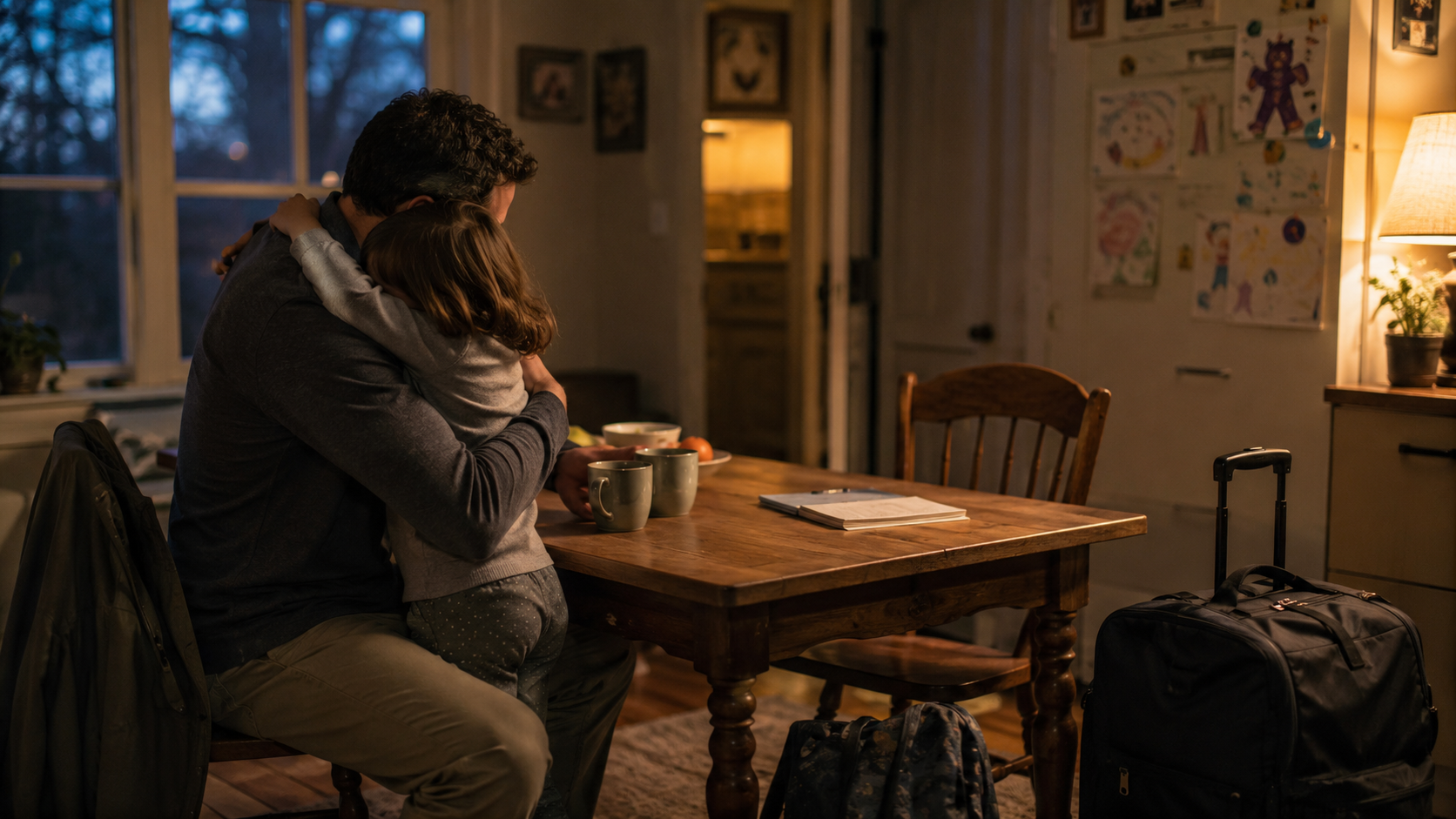
A quiet note on long-distance marriage, children, and the strange ache of returning to a life that has learned how to continue without you.
There is a kind of distance that does not announce itself dramatically.
It does not arrive with slammed doors or final conversations. It does not always look like betrayal, indifference, or the slow collapse of love. Sometimes it looks like a suitcase beside the kitchen table. A child who hangs back for a moment before hugging the parent they have missed. A spouse standing in the doorway of their own home, suddenly unsure where they fit.
This is one of the quieter griefs of long-distance marriage.
People talk about missing each other. They talk about phone calls, time zones, lonely evenings, and the ache of sleeping apart. But they speak less often about the visit itself. The return. The moment everyone expected to feel simple, only to discover that the family has developed a new rhythm in the absence.
One parent knows the routines now. Which child needs warning before bedtime. Which cup belongs to whom. Which silence means tiredness and which silence means trouble. The home has adapted, because homes do that. Children do that. The parent who stays has no choice but to become the structure.
Then the other parent comes back.
Not as a stranger, exactly. Not as a guest, exactly. But not as fully inside the rhythm either.
There may be love in the room and awkwardness at the same time. There may be relief and resentment. There may be tenderness, but also the faint discomfort of rearranging yourself around someone who still belongs to you, but no longer belongs to the ordinary shape of every day.
Sometimes the hardest part of long-distance marriage is not being apart. It is discovering what the distance has changed when you are finally together again.
Children feel this too, though rarely in clean sentences. A child may become shy around the parent they have been waiting for. They may cling too tightly, act indifferent, show off, test boundaries, or suddenly become difficult. Adults often want these reunions to prove something reassuring. Children are less interested in proof. They are trying to feel safe again.
That is why visits can become so emotionally loaded. Everyone is hoping the same short stretch of time will do too much. The couple wants closeness. The children want security. The visiting parent wants to matter. The parent at home wants help, recognition, and maybe rest. The whole family wants the visit to feel natural, even though distance has made naturalness something that has to be rebuilt.
This is not always a sign that love has disappeared. Sometimes it is a sign that the family has been living in fragments. One part over here. One part over there. Then, for a few days, those fragments are asked to become whole again.
Wholeness does not always happen on command.
There is a painful humility in this. The returning spouse may have to enter slowly, not taking over, not assuming the old rules still apply, not demanding instant closeness from children who need time. The parent who stayed may have to admit that they are glad their spouse is home and overwhelmed by their presence. The children may need permission to be awkward without being made responsible for adult disappointment.
A visit is not a performance. It is a re-entry.
And re-entry is delicate.
For anyone living inside that strange emotional territory, this Left Unsaid article goes deeper into the pattern: long-distance marriage with kids when visits feel awkward.
What matters is not whether the first hour feels perfect. It probably will not. What matters is whether the awkwardness can soften. Whether someone can say, gently, “This feels strange, but I want to find our way back.” Whether the returning parent can become familiar again without forcing it. Whether the parent who stayed can be seen, not just expected to make room. Whether the children can move toward closeness at the pace their small bodies can manage.
Distance asks families to survive apart.
Visits ask them to remember how to be together.
That remembering can be clumsy. It can be quiet. It can begin with unpacking a bag, making tea, sitting at the same table, letting the children circle closer, and allowing the house to slowly make room again.
Not all awkwardness is failure.
Sometimes it is the sound of a family trying to become familiar to itself again.